

There is a particular kind of uncertainty that can develop when your recollections, perceptions, and interpretations are repeatedly challenged by someone whose account seems to take precedence over your own.
Eventually, the disagreement may no longer be about what happened. It becomes about whether you can trust yourself to know.
This is where the conversation about gaslighting needs to begin.
Couples disagree. Partners remember evenings differently. People invalidate each other without meaning to. Those experiences are real, and they are not automatically abuse. What this Field Note is about is something narrower and more serious: a recurring pattern in which one person undermines another’s trust in their own perceptions, which can occur in a relationship where power, isolation, or credibility already tip the balance.
Precision matters here. The word “gaslighting” has entered everyday speech with meanings broader than the pattern described here. Using it for any frustrating argument risks blurring that pattern and making it harder to recognize when it is actually present.

What the Word Is Trying to Name
Scholars do not all define gaslighting the same way. Fields disagree about whether conscious intent is required, whether a single incident can count, and whether a power imbalance is necessary. Careful use of the word leaves room for those differences.
For this note, Sage & Atlas uses a working definition drawn from qualitative research with survivors of intimate partner violence and from sociological work on power in abusive relationships. Gaslighting, as we use the term here, involves two linked parts: behavior that undermines another person’s sense of reality, and a resulting erosion of that person’s confidence in their own knowing. The pattern can be made more consequential when it is embedded in unequal power, including gendered stereotypes, institutional leverage, or isolation from people who might offer a different account. Researchers are not fully agreed on whether a power imbalance is always required. Some qualitative work finds imbalances common but not necessary in every reported case. We treat that as an open question, not a settled rule.
An isolated lie, a defensive denial, or a heated disagreement can be harmful without being gaslighting. The difference that matters for this note is recurrence and effect: a pattern that undermines a person’s trust in their own perceptions.
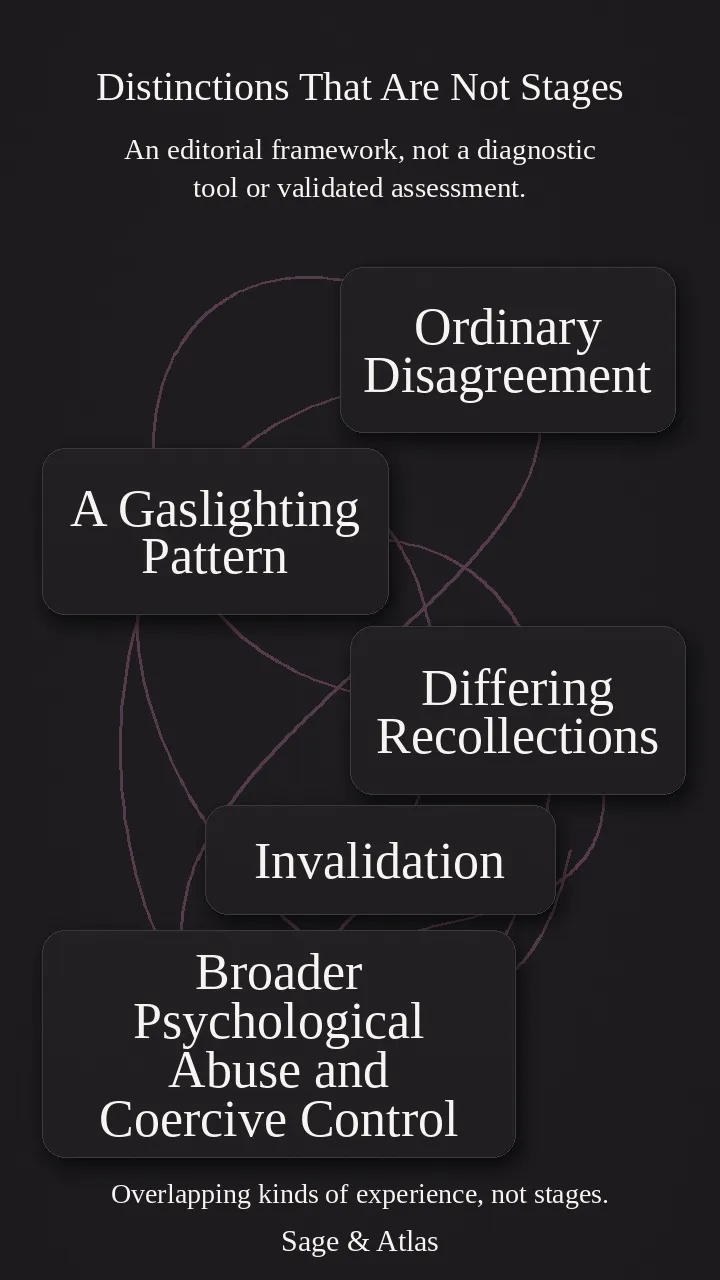
Distinctions That Are Not Stages
It can help to keep several kinds of experience separate. These are overlapping distinctions, not steps on a path. One does not inevitably become the next.
A Sage & Atlas editorial framework for clarity; not a validated typology or a diagnostic tool.
These are overlapping kinds of experience, not stages of a relationship. Naming them separately is meant to protect seriousness, not to invite readers to classify a partner after one hard conversation.
Ordinary Disagreement
Two people hold different views, priorities, or readings of a shared situation. That is conflict, not proof of abuse.
Differing Recollections
Two people remember the same evening differently. A mismatch in recollection is not, by itself, evidence that someone is being gaslit. It is also not a reason to treat survivors’ accounts as generally unreliable.
Invalidation
A response that dismisses feelings, reactions, or meanings as wrong or unimportant. Invalidation can happen once or repeatedly. It can wound. It is not automatically gaslighting.
Broader Psychological Abuse and Coercive Control
Patterns of denial, minimization, blame shifting, isolation, intimidation, and control of resources or narratives are studied extensively in intimate partner violence research. Some of those tactics can appear inside a gaslighting pattern. Psychological abuse and coercive control are not interchangeable terms, and neither is identical to gaslighting. Calling behavior manipulative does not, by itself, establish the narrower pattern described here.
A Gaslighting Pattern
Recurring behavior that undermines another person’s sense of reality and erodes confidence in their own knowing, which can be compounded by power and isolation.
How the Pattern Can Show Up in Intimate Relationships
In the survivor accounts informing this note, gaslighting includes repeated contradiction of events, minimization of harm, blame shifting, attacks on memory or judgment, and manipulation of the story of what “really” happened. Isolation from friends, family, or other witnesses can make the pattern harder to interrupt, because fewer people remain who can offer a counter-narrative.
None of those behaviors, taken alone, proves gaslighting. Context, repetition, and the effect on a person’s trust in their own knowing matter. The qualitative accounts informing this note center survivors’ experiences. Their sample and design limits belong in the evidence note; those limits are not a reason to presume that survivors are unreliable.
What This Can Do to Self-Trust
In Hailes and Goodman’s interviews with 14 survivors whose abusive relationships had ended, participants described doubt in their memory, perception, judgment, and right to name what happened. The loss is not simply agreement about an event. It is confidence in their own ability to understand and describe it. Gaslighting co-occurred with other forms of abuse in that study, so these accounts cannot isolate its contribution to every harm described.
Broader research on psychological intimate partner violence and coercive control links those wider forms of abuse with serious mental health outcomes, including posttraumatic stress and depression symptoms. Those findings describe larger categories of harm. They should not be read as if every outcome belongs to gaslighting alone, or as if every person experiences the same effects.
Personality, Diagnosis, and Harmful Behavior
Personality disorders and certain personality traits can be part of the conversation about harmful interpersonal behavior, including manipulation and gaslighting. Some people with personality disorders may use these behaviors in relationships, and the effects on the people around them can be deeply damaging. That reality deserves acknowledgment without assuming that everyone with a particular diagnosis behaves this way.
A diagnosis does not excuse abusive behavior. And a diagnosis is not required to recognize it. The more important question is not what label someone might carry, but what they repeatedly do, how they respond when their behavior is challenged, and what that pattern does to another person’s ability to trust their own experience.
Recognizing a Pattern Without Diagnosing Anyone
Recognizing a pattern does not require diagnosing the other person.
Recurring contradiction, minimization, or attacks on judgment matter in context, particularly alongside pressure to accept only one person’s account. Feeling uncertain is not itself proof of gaslighting. The question is not whether you can be certain about every detail, but whether disagreement leaves room for your perceptions to be considered at all. This is a lens for reflection, not a test.
Confrontation is not always safe. Documentation is not always safe. If checking notes, telling someone, or challenging a partner could increase harm, safety comes first. Seeking support from a trusted person or a qualified service is a judgment only you can make in your circumstances.
This note does not establish that journaling, boundaries, or conversation restore self-trust. It offers reflection, not a tested intervention or treatment guide.
This Field Note is educational reflection. It is not therapy, legal advice, or a substitute for professional or safety support.
A Moment to Consider
These prompts are optional and do not need to be written down. Skip any that do not feel useful or safe.
- What do I remember happening, in my own words?
- What am I being told happened?
- Where is there room for uncertainty, and where do I feel pressured to accept only another person’s account?
- Do I notice a recurring pattern, or a one-time rupture?
- What would help me feel safer or more supported right now?
- Is there someone trustworthy I could speak with, if and when it feels safe?
This is reflection, not diagnosis. Privacy matters: shared devices and accounts are not always safe places to keep notes.
Finding Your Way Back to Yourself
Rebuilding trust in yourself after gaslighting can be a long, winding process. The uncertainty may not disappear simply because the relationship changes or because you finally have language for what happened. You may find yourself revisiting old conversations, questioning decisions, or wondering whether your understanding can be trusted again.
That does not mean you are failing to move forward. It means the effects of repeated psychological undermining can reach beyond the moments in which it occurred.
Learning to trust yourself again may involve time, distance, support, and the freedom to make sense of your experiences without having every detail challenged. Distance is not always safe, and none of these is required. There may be days when your perspective feels clear and others when old doubts return. Progress does not require perfect certainty about the past.
What happened to you matters, even if you are still working out how to understand it.
You do not have to reconstruct every conversation perfectly, prove another person’s intentions, or obtain a diagnosis before taking the effects of a recurring harmful pattern seriously.
If you recognize something of your own experience in these pages, finding your way back to your own perspective may take time. You deserve that time.
Research & Perspectives: The companion evidence note explains the evidence behind this article and its limits.